Author: Anne Hurenkamp Photography: Thomas Busschers (Dienst Marketing Communicatie) Date: 9 December 2025
Source: Saxion news
Ilse ten Bruggencate wins two awards for her master research
Anyone who has ever looked out of an airplane window will recognize them: the moving flaps at the end of the wing. They are closely connected to the research of lecturer and researcher Ilse ten Bruggencate. For her master’s degree in Polymer Engineering, she investigated the impact of repeated recycling on the properties of materials used in aircraft components. Future legislation will require the industry to implement recycling solutions. Highly relevant research, which earned Ilse both the SAMPE Student Master Award Europe and the Aanjager Award. We visit Ilse at the Thermoplastic Composites Application Center (TPAC) at Saxion, where she can be found almost daily.
In recent years, Ilse and her team have been deeply involved in research into material recycling, for example for safety shoes and access panels. This research led to many new projects, she explains. “And every time such a project was completed, someone would say: ‘But could I recycle this material one more time?’” Not only a curious question, but also a relevant one, because major industries such as aviation and automotive will soon be confronted with European legislation requiring companies to take responsibility for materials that return at the end of their products’ life cycles. Ilse explains: “We’re not there yet, but in the future this will become a problem. When aircraft reach the end of their service life, you’re left with material that is difficult to recycle. That volume will increase. That’s why research into recycling processes and their impact on material properties is needed.”
Recycling five times
Ilse therefore decided, for her two-year part-time master’s program in Polymer Engineering at NHL Stenden and Windesheim, to investigate repeated recycling of aircraft component material: C/PPS (Carbon Fibre Reinforced Polyphenylene Sulphide). “All my ongoing research projects were related to recycling, and it seemed logical to explore one of them in more depth for my master’s. I chose to frame the research question as follows: how can this material be recycled repeatedly, five times, while retaining as many of its mechanical properties as possible? An aircraft has a lifespan of 20 to 25 years, so with five recycling cycles you already cover a period of more than 100 years.”
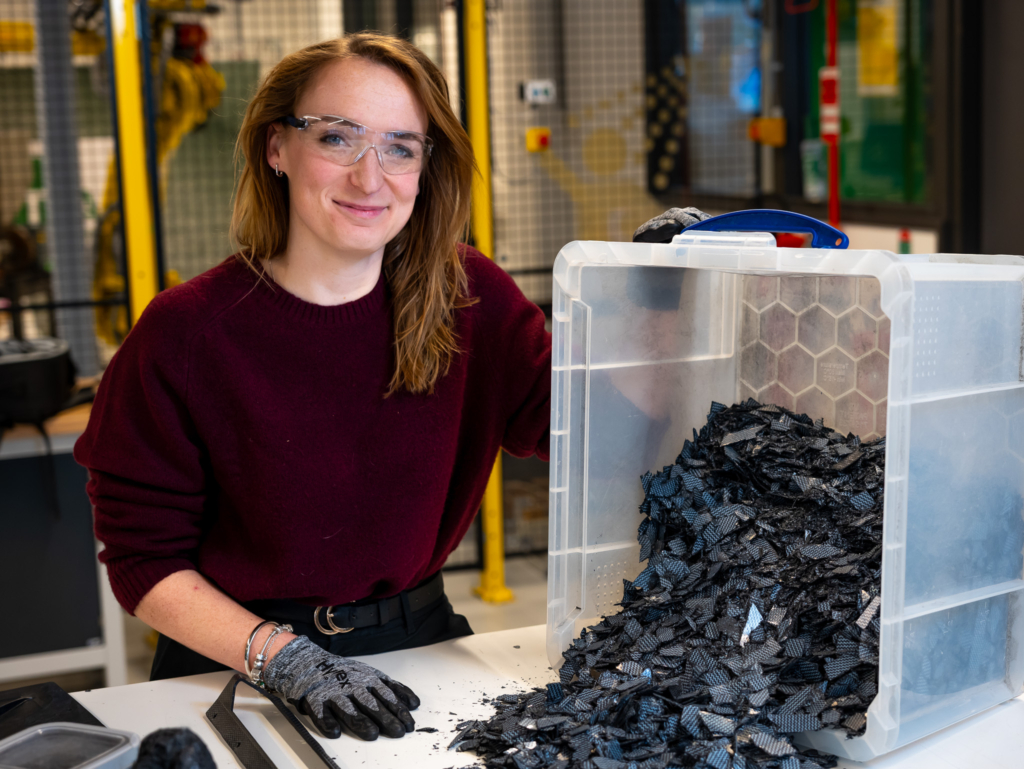
Ilse ten Bruggencate: “When aircraft reach the end of their service life, you’re left with material that is difficult to recycle. That volume will increase. That’s why research into recycling processes and their impact on material properties is needed.”
Moving flaps
Back to those moving flaps at the ends of the wings or on the tail section. Are those the parts involved? “Not exactly. Because material use in aviation is extremely critical, we initially focus on less critical components. If we look at the flaps, for example, we try to apply recycled material to access panels in the wings. Or to the covers that protect the hinges of the flaps. They provide access to what lies beneath. A maintenance technician removes them during inspections or maintenance work. There is already a lot to be gained here, because currently these parts are made from new and very expensive materials, even though that isn’t actually necessary for this application.”
Relevance
Ilse began her research with a literature review to assess the relevance of her research question. There was plenty of data available on recycling consumer waste, but hardly any on this type of composite from the aviation industry. “Household plastic waste has a shorter lifespan and is recycled more frequently. That processing route is different. But for the high-performance materials I focused on, there was hardly any data available. So the relevance of this research was certainly there.” Ilse then focused on the composition of the composite: a fiber and a polymer. What would happen to these materials during five recycling cycles?
“Household plastic waste that is disposed of in the plastic recycling container has a shorter service life and is recycled more frequently. The associated processing route differs accordingly. However, there was scarcely any data available on the recycling of the high-value materials that were the focus of my research.”
Wind, UV radiation, pollution
Ilse then started producing the material itself. She recycled it five times and analyzed the test results, all under laboratory conditions. “Normally, such a material would be part of an aircraft for years, exposed to wind, UV radiation, and pollution. I left those factors out of consideration. That could be a topic for follow-up research. The focus here was on the processing route, because even there many complex mechanisms take place.” Ilse hypothesized that repeated recycling would lead to a decline in the mechanical properties of the material, caused by a reduction in fiber length and degradation of the matrix material. “Based on the literature, I expected this to become visible in the mechanical properties after the second or third recycling cycle.”
Substantiation
This was confirmed by the tests. After the first recycling cycle, the properties actually showed a slight increase, followed by a decrease in subsequent cycles. The material can indeed be recycled five times, Ilse explains, but the question is for which applications it can still be used. It may still be possible to use the composite for non-structural applications. “If you had asked me beforehand whether recycling would be possible, I would have said: ‘Yes, why not?’ But I wouldn’t have been able to answer what the precise effects of recycling were, let alone provide substantiation. This research now provides that precise substantiation for this material.”
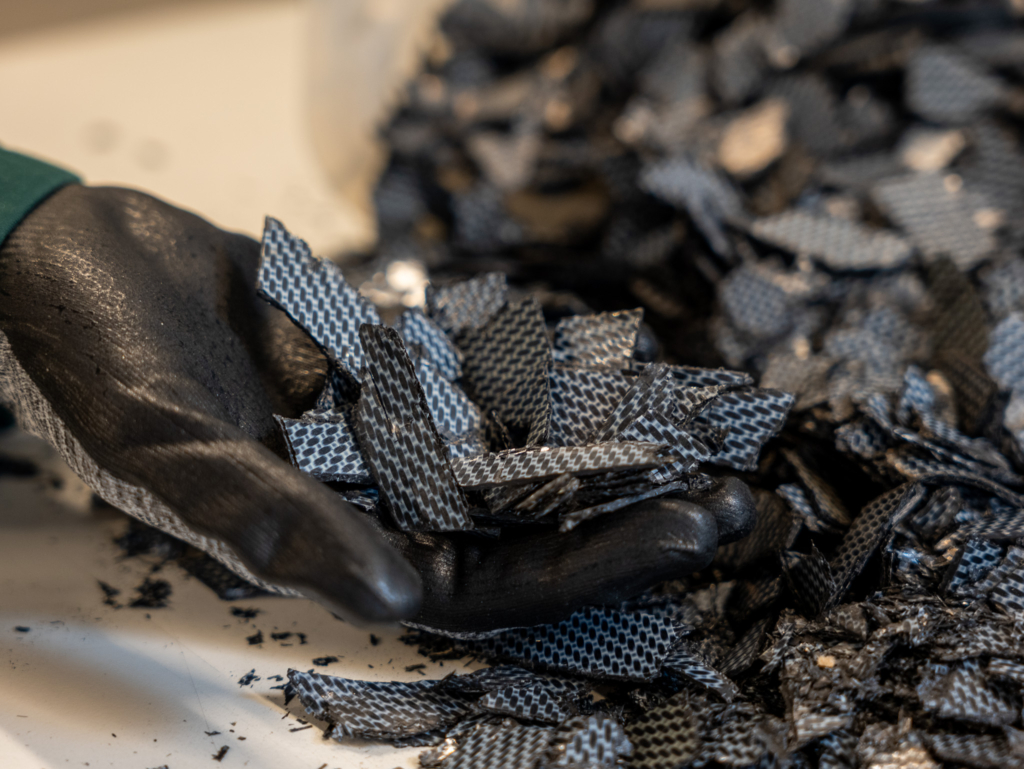
Ilse ten Bruggencate: “Normally, such a material would be part of an aircraft for years, exposed to wind, UV radiation, and pollution. I left those factors out of consideration. That could be a topic for follow-up research. The focus here was on the processing route, because even there many complex mechanisms take place.”
SAMPE Award
Ilse completed her master’s degree in February of this year. In May, she submitted her research for the SAMPE Benelux Award, which was presented during the professional organization’s conference. The two winners, for best master’s and PhD research, were allowed to advance to the SAMPE Europe Conference. “Because I won the Benelux award, I was indeed able to compete for the European prize in October. Student presentations take place during the two-day conference.” Once again, Ilse emerged as the winner. This earned her a place at the SAMPE USA Conference, while the winner of that conference is invited to present in Europe. “It’s a great professional development trajectory, allowing me to exchange knowledge with a group of other winners from all over the world.”
Follow-up projects
Does her research end here? “No, I see this as part of a long research line, with opportunities for follow-up projects. For example, two students from the Saxion Chemistry program are working, as part of their minor Sustainable Advanced Materials, on a sub-study of the polymer that of the composite I researched. They are taking a deeper dive into that. Other student groups from programs such as Mechanical Engineering, Mechatronics, and Electrical Engineering have worked on related projects. That’s what’s great about working at Saxion: you can give follow-up steps or deeper explorations a place in new student projects.”
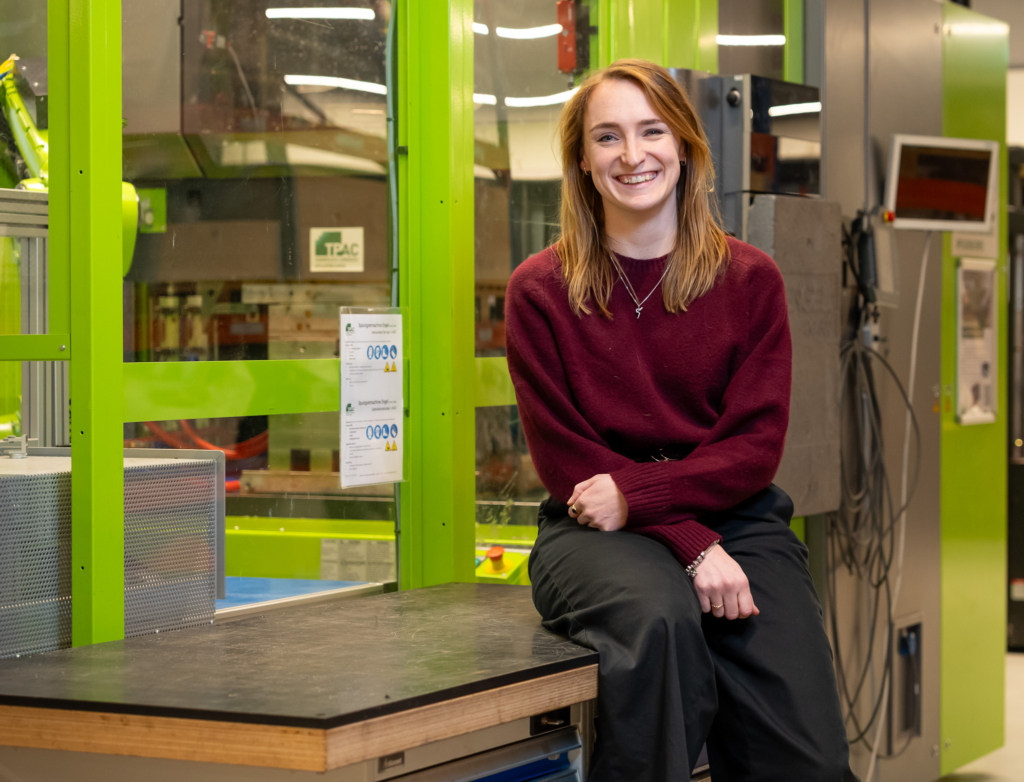
Ilse ten Bruggencate: “This research can provide the industry with tools to process its own residual streams.”
Blueprint for the automotive industry
Can her research approach also serve as a blueprint for follow-up research in the aviation or automotive industry? “Yes. This research can provide the industry with practical guidance on how to process its own residual material streams, especially if new guidelines are introduced in the future. Right now, there is still a lot of uncertainty about the approach, not only regarding recycling itself, but also regarding repeated processing of the same material. My research gives an indication of what is possible with this material. The reason I started with C/PPS is that it still has significant economic residual value. It’s an expensive material, which makes it even more relevant for industry to want to do something with it. My research can also serve as a blueprint for the automotive industry, where glass-fiber-reinforced materials are more commonly used. These issues will arise there in the future as well.”
Close-knit team
A master’s degree is an individual trajectory, yet Ilse felt strongly supported by her colleagues from the Lightweight Structures research group, she says with a smile. “We’re a small, close-knit team. So you never really go through such a process completely alone. There’s always someone who thinks along with you, lends a hand, or helps with the machines in our lab. Almost the entire team was present at the defense of my master’s thesis as well, on a weekday with everyone’s busy schedules. When I looked into the room, it gave me a warm feeling. Even though it was my master’s research, it felt like I hadn’t done it alone.”
Aanjager Award
Ilse ten Bruggencate’s graduation research received yet another award last week. On December 4, 2025, Ilse and her research were also named one of the two winners of the Aanjager Award. This award is presented annually to students who, through applied or fundamental scientific research and public engagement skills, have made an important contribution to solving problems and challenges in the field of circular plastics. The research must be relevant to the development of these plastics in the Northern Netherlands. Participating institutions include the University of Groningen, NHL Stenden University of Applied Sciences, Van Hall Larenstein University of Applied Sciences, and Hanze University of Applied Sciences.